
By Uchenna Ekwo
NEW YORK — The United States government’s new “Trade over Aid” initiative has expanded its global footprint, with 46 countries now signed on to the free-market development strategy launched by the Trump administration.
However, despite the administration’s aggressive push to pivot away from traditional foreign assistance, African participation remains noticeably low. Of the nearly four dozen signatories, only six African nations have joined the scheme, with Nigeria taking a prominent but measured role.
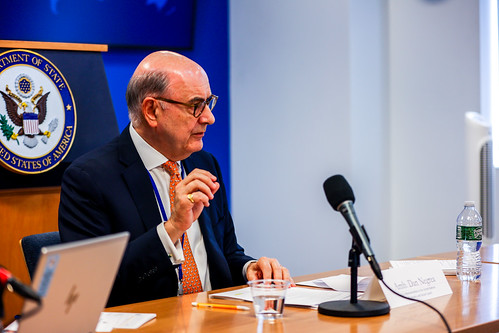
Speaking to foreign correspondents in New York, Ambassador Dan Negrea, U.S. Representative to the UN Economic and Social Council, framed the initiative as a “contest of ideas” designed to instill free-market principles worldwide.
The program, which held its high-profile launch at the New York Stock Exchange, actively challenges international frameworks like the United Nations Sustainable Development Goals (SDGs). Negrea openly criticized the SDGs, characterizing them as a “soft form of global governance” that over-regulates developing countries and deprives them of the freedom to chart their own unique economic trajectories.
The ambassador rejected claims that the policy represents an American isolationist retreat under the “America First” banner.
“America First does not mean America Alone,” Negrea emphasized, asserting that the U.S. still believes in targeted aid but is fiercely determined to eliminate waste, duplication, and dependency.
Low African Footprint and the “Dead Aid” Playbook
The mechanics of the Trade over Aid initiative heavily echo the economic philosophies of Zambian-born economist Dambisa Moyo. In her landmark book Dead Aid, Moyo famously argued that decades of systemic foreign grants have fueled corruption and stalled self-sustaining growth across Africa, advocating instead for trade, micro-finance, and capital market access.
Yet, translating that theory into broad African consensus has proven difficult. Out of 46 total member states, the vast majority of signatories hail from Eastern Europe, the Middle East, and Latin America.Nigeria, Africa’s largest democracy, has chosen to participate by contributing mentorship programs to a newly established U.S.-led digital library—an entry-level tier of involvement compared to the deep private-sector integration the U.S. is seeking.
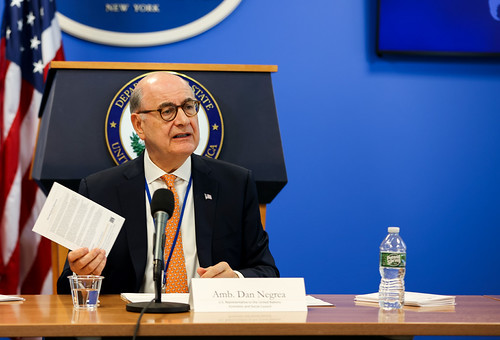
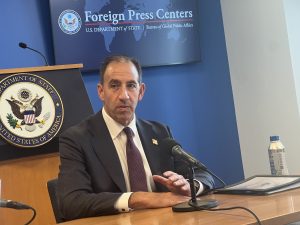
Ambassador Dan Negrea addressing a news conference at the Foreign Press Center, New York
The Visa Paradox: Can the White House’s ‘Trade over Aid’ Strategy Succeed Amid Strict Border Policies?
Visas and Dismantled Agencies
The briefing exposed clear operational friction points for the newly minted initiative. When pressed on whether the policy is simply a recycled version of the United States Agency for International Development (USAID)—which was dismantled by the administration last year—Negrea sidestepped a direct comparison. He did, however, sharply criticize the defunct agency, labeling it as a hub for mission creep, inefficiency, and bureaucratic waste.
Furthermore, journalists raised concerns regarding how the administration’s tight immigration policies might cripple a program reliant on international commerce. Because a trade-first model requires the seamless movement of entrepreneurs, investors, and technical experts across borders, strict U.S. visa policies could form a major bottleneck.
Negrea parried the question, acknowledging that while his office lacks the authority to dictate visa policy, he believes there are “several ways trade could be conducted” even under highly restrictive visa regimes.
While proponents view the initiative as a bold, necessary disruption to a broken global aid complex, critics warn that strict border barriers and a lack of baseline institutional funding may keep the program from unlocking the robust private investments developing nations actually need.